Thursday, December 4, 2008

gluten-free dark chocolate torte

Over the years, I've become fairly proficient at baking and cooking gluten-free fare; I have a family member afflicted with celiac disease, meaning absolutely no wheat gluten (or barley or rye). At thanksgiving or other family gatherings, I used to make up extra pumpkin pie filling and make a crustless pie for them, or some such rendition of what the rest of us were eating. This still seemed exclusionary to me. I had a friend share an amazing recipe of a blend of special flours that can be used in a 1:1 substitution with all-purpose flour:

2 cups brown rice flour
2/3 cup potato starch
1/3 cup tapioca starch

This blend is a complete life-saver! I've found these specialized flours from Whole Foods and other natural food stores. Bob's Red Mill makes all of them (plus many more varieties). I've successfully used it in bread recipes, pastry, etc. The results are drier and more apt to crumble than their glutenous counterparts, but it is still surprisingly workable and able to maintain structure.  It also lends an interesting taste and textural difference that is a nice break from wheat. Don't believe me? Check out the Dark Chocolate-Pomegranate Torte I made for thanksgiving:


Wednesday, November 26, 2008

How to Deconstruct a Pumpkin

There were sugar pumpkins at the fruit stand today. Since I've been charged with bringing pumpkin pie (and mashed potatoes and cranberry sauce) to my Thanksgiving gathering, I figured I'd take the unknown route, and give a good excuse for a how-to picture post. (I followed this site.)

How-To: Turn a Solid Pumpkin Into Puree
1. Preheat oven to 350°F, wash the pumpkin and remove stalk.

2. Using a large knife or, in this case, a cleaver, slice pumpkin in half.


3. Scoop out stringy center and seeds. (Put seeds aside for delicious roasting, of course.)


4. Fill a pan with 1/2" of water and place pumpkin halves cut-side down.

5. Roast for an hour, or until skin pierces easily.

6. Remove pumpkin flesh from the skin and food process until smooth.


Ok, baby food level might have been TOO smooth. That's ok, I'll just mix it in with the less-processed batch.


Check in after Thanksgiving for the whole pie, and tomorrow for the pie crust.

Saturday, November 8, 2008

Baking in Monochrome

We had leftover oranges at work, so I took some home to make orange bowknots from Better Homes and Gardens. The sweet, yeast rolls will be excellent for a brunch book group tomorrow.

I basically followed the recipe, extending the rises to accommodate slow yeast (probably due to a cold house) and substituting one of the eggs for 1/4 c pumpkin puree. (I was out of eggs.) The pumpkin made the dough delightfully orange!

(Click the images for larger ones)


This recipe made me really realize how much I've grown as a baker in the past two years. The first time I made them with with a friend, the rolls tasted great but the texture was dense, and they weren't appealing cold. These...are proper, fluffy, sweet and orangey rolls. Even though the orange peels were ugly, adding suspicious dark flecks to the dough, even though a few tiny seeds slipped through the strainer, they're tasty. I don't think it's that I'm paying more attention to the recipe--I've always brought my lab technique into the kitchen--I think it's more that I have an idea of what things should be like and I take steps to correct errors before they cause issues.

Question for our tiny readership: How much do you guys appreciate process photos? We'll take them as frequently as we remember, but if it annoys you, we can refrain from posting them all. At least, I can.

Sunday, October 26, 2008

Oatmeal-Molasses Bread

Fall makes me want to bake. It's probably the changing leaves, the chill and the all-encompassing wetness that puts me in the mood for homemade soup and bread. Of course, the blazing heat of a PNW summer also makes me want to fire up the oven, so maybe I just really like this hobby.

So it's fitting that I chose a bread recipe from "Dairy Hollow House Soup and Bread" book: "Rabbit Hill Inn Oatmeal-Molasses Bread". We seem to be on a molasses kick at our house.

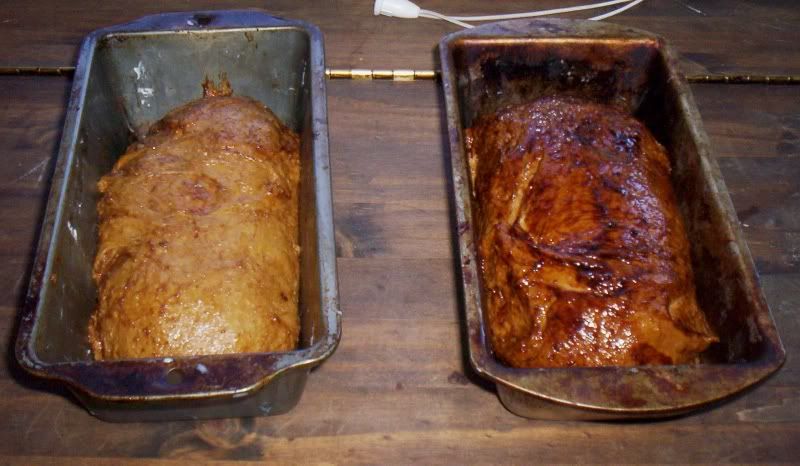
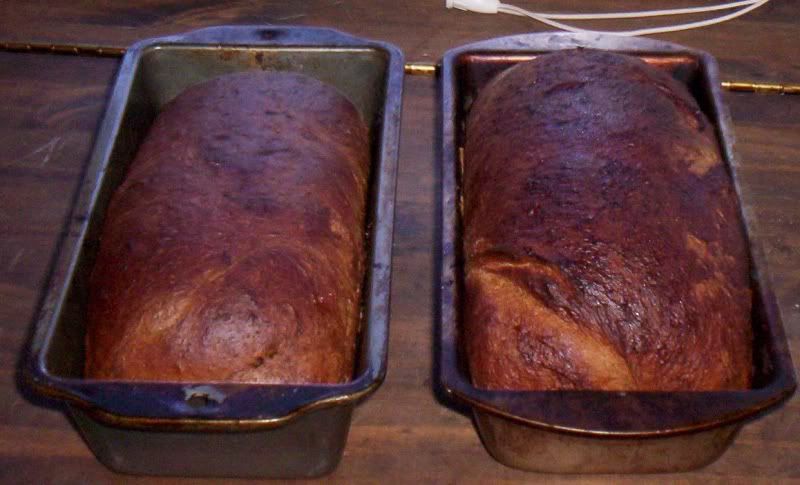
I went a little overboard on the blackstrap molasses, since there were only a few tablespoons left in the bottle and I love the taste. The loaf on the left has that extra molasses kneaded into the dough, and the one on the right just has the molasses smeared on top. (What's the effect of molasses as a glaze? Let's find out!) I also added vital wheat gluten, as I've taken to doing for my bread. If it's added any lift or shelf life, I wouldn't know because I haven't done a non-additive control.

My right wrist is bothersome, so I left the majority of the kneading up to the stand mixer and dough hook. It's a pretty sticky dough anyway.


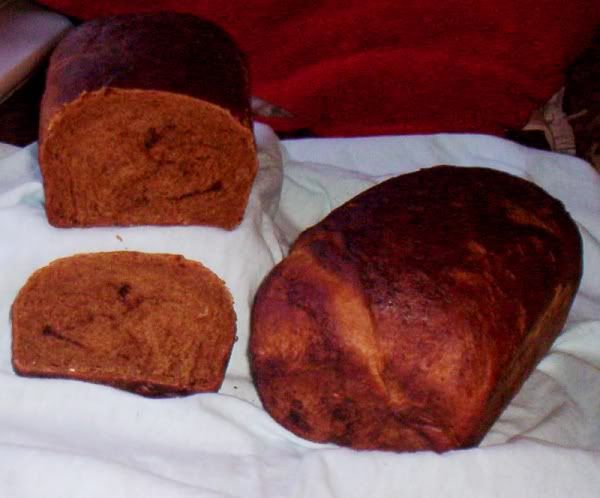
I baked them at 375F for 30-odd minutes, spritzing with water generously and turning halfway through, then pulled them out when their internal temp was 210F. So what effect does a molasses glaze have on a bread? The crust is darker by a good lot, but there aren't other differences that I can tell.

They took forever to cool, but are deliciously worth the wait! They're sweet--thanks to the molasses--and like a sandwich bread in texture. The oatmeal didn't survive to lend anything to the texture, except perhaps to make it moister. I love how the molasses is swirled into the kneaded-in dough. It's almost like a cinnamon loaf.

Thursday, October 16, 2008

iron chef -- brussel sprouts!

Chairman Gretchen says: A la cuisine!

In a house of two excellent cooks, iron chef battles are inevitable. We had some extra brussel sprouts lying around and couldn't agree how we wanted to prepare them, so we each made our own rendition. I like mine quickly sautéed over high heat, which keeps them fresh and crispy, with that excellent peppery bite. I've come to learn this is the South American style, where young women are deigned ready for marriage when they learn to slice greens as thinly as possible. Apparently, I have a while. This shredded preparation lets the sprouts cook in about a minute over medium high heat. Bacon was, of course, added.


Jess' preparation was more traditional. The sprouts were halved and tossed with olive oil. Again, bacon was added. They were baked until soft and roasty. Yum!

little cakes

I like challenges. I like trying difficult recipes just to see if I can do them. It seems that once you have built up a set of core techniques and fluency with recipe language, there aren't many things you can't do.


When my mother emailed me this recipe for madeleines (ahem--lemon-glazed madeleines) I knew this was my next opponent. I had been schlepping the fancy pans around with me for years, and never had the courage to use them.


Oh my. Warm from the oven, they were divine. I had planned to bring these to a friend's farewell party, but I doubt they will last that long. I might just make a fresh batch tomorrow.

harvest

Our house has been completely inundated by tomatoes this season. We have about five cherry tomato plants in our side yard that just don't know when to stop! I've even had enough to make tomato sauce from scratch... twice! That's a lot! I was too busy eating to take pictures of the finished product, but it was so good I wanted to share the recipe, adapted from the indelible Marcella Hazan (The Classic Italian Cookbook):

2 lbs fresh ripe tomatoes, halved lengthwise
1/2 cup olive oil
medium-sized sweet onion, finely minced
~1/4 tsp granulated sugar

~2 tsp salt
1 small can tomato paste (totally cheating)
A few sprigs of fresh oregano, stems discarded.

1.
wash tomatoes, then cut in half. Simmer in a covered saucepan for 10-15 minutes until flesh softens.
2. Purée tomatoes in food mill or food processor. If using the processor, push the purée through a fine-mesh strainer to remove seeds and skin.
3. Add the olive oil to a clean saucepan, add the onion and sauté until just translucent. Add the tomato purée, paste, sugar, salt, and oregano. Cook uncovered at a steady simmer for 40 minutes or until desired consistency. Check seasoning and adjust as needed. Add some fresh leaves of oregano right at the end for color.

Since I used cherry tomatoes as the base (Roma is more traditional), I added less sugar. Also, cherry tomatoes have a higher ratio of gooshy seed:usable flesh, so I added the tomato paste to thicken things up. This was not in Maricella's original recipe. Also, she calls for the classic Mirpoix (holy trinity) of onion, carrot, and celery. I personally don't enjoy veggie chunks in my pasta sauce, so I only used the onion. I also like oregano in my tomato sauce, so in that went.


Like I said, the sauce was polished off before photographic evidence could be collected, so here's a picture of the tail-end of the harvest. I had to use three times this quantity for the sauce. Also, the zucchini and raspberry plants found the energy to give us a small sample.